Strategy
When to Ignore a CTR Opportunity
Not every low-CTR page deserves a rewrite.
2026-10-08 · CTRPilot
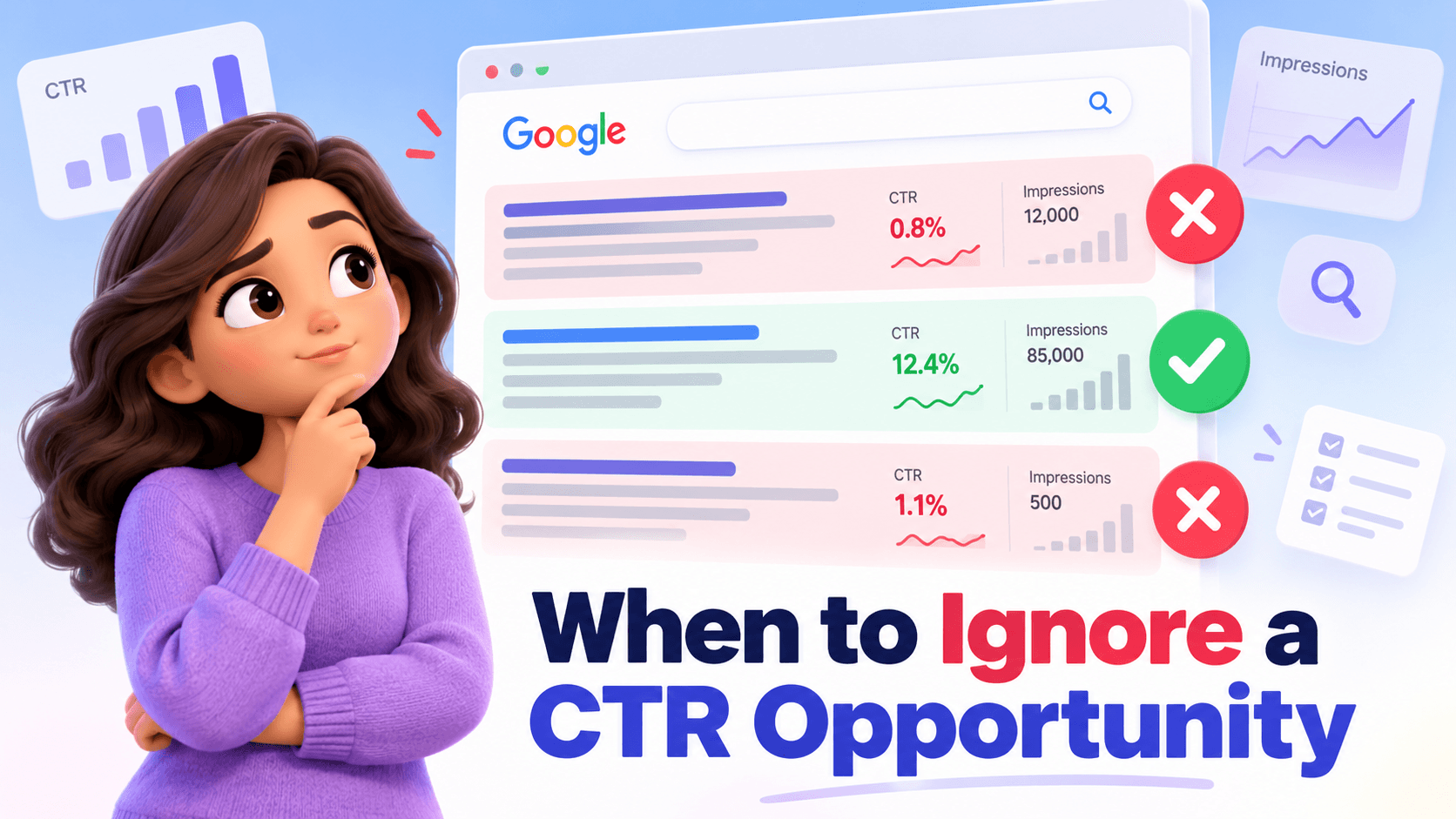
When to Ignore a CTR Opportunity
Not every low-CTR page deserves a rewrite.
Open Google Search Console, sort by impressions, and you'll find plenty of pages that seem to be "underperforming": lots of impressions, but not many clicks. The natural reaction is to rewrite every title and meta description you can.
That approach usually wastes time. Some low-CTR pages are fine as they are. Some can't be improved in a way you could measure. Some were never meant to get clicks at all.
Good CTR optimization depends on choosing what to fix, and that means deciding what to leave alone. Below are the three situations where ignoring a CTR opportunity is the right call.
Why Ignoring Opportunities Matters
Each title test takes time to write, time to run, and time to analyze. If your optimization list is full of items that will never pay off, three things happen:
- High-value pages get buried under noise.
- Experiments get spread too thin, so fewer of them finish with a clear result.
- Your team stops trusting the list. Once people know half the items are irrelevant, they stop checking it.
A short list where every item matters will beat a long list nobody acts on.
1. The Query Is Branded and CTR Is Already Strong
Branded queries include your company or product name, such as "CTRpilot login" or "CTRpilot pricing." People searching for them already know who you are and are usually trying to reach you directly.
Why to Ignore It
- CTR on branded queries is usually high to begin with, so there's little left to gain.
- Searchers will click your result no matter how the title is worded.
- When branded CTR does drop, the cause is usually outside the title: sitelinks, a competitor bidding on your brand name, or a SERP feature that answers the query directly.
When Not to Ignore It
If branded CTR is clearly low, look into it. It can mean a competitor's ad is taking your clicks, an outdated page is ranking ahead of the right one, or something on the SERP is confusing searchers.
That's a brand-protection problem, though, and rewriting the title won't fix it.
2. The Page Is Intentionally Thin (Legal or Policy Pages)
Privacy policies, terms of service, refund policies, cookie notices, and similar pages often pick up impressions for long-tail queries. Their CTR tends to look weak.
Why to Ignore It
- These pages exist for compliance and trust, not for traffic.
- More clicks on your terms of service won't affect revenue, signups, or engagement.
- Writing "optimized" titles for legal pages can make them less clear, and clarity is what those pages need.
Rule of thumb: If more clicks to a page wouldn't change any business metric you care about, its CTR isn't worth optimizing.
3. Impressions Are Too Low for a Clean Experiment
This one is the easiest to miss.
Suppose a page has a 3% CTR on 150 impressions a month. It looks like an opportunity, but the numbers are too small to work with.
Why to Ignore It (For Now)
- With low impression volume, ordinary week-to-week variation can be bigger than any effect your title change has.
- You'll have trouble telling whether a CTR change came from your new title or from chance, seasonality, or a ranking movement.
- Even if the test works, the absolute gain is small. Better CTR on a handful of impressions still adds up to only a few extra clicks.
What to Do Instead
Check the page again once impressions grow.
A page that moves from low volume to steady, meaningful volume can become a real candidate later. A page's place on your list should change as its data changes.
A Quick Decision Checklist
Before you rewrite a title, ask:
| Question | If "Yes"... |
|---|---|
| Is the query mostly branded, and is CTR already healthy? | Ignore it |
| Is it a legal, policy, or utility page that isn't meant to drive traffic? | Ignore it |
| Are impressions too low to measure a title change reliably? | Ignore for now and check again later |
| Would more clicks to this page move a business metric? | Prioritize it |
| Is there enough impression volume to run a clean before/after test? | Prioritize it |
Ignore vs. Resolve: Keeping Your List Clean
You can take an item off your list in two ways:
- Resolve it when you've acted on it, for example, by shipping a new title or fixing the underlying issue.
- Ignore it when you've decided it isn't worth acting on for one of the reasons above.
Both keep your working list limited to items that still need a decision.
In CTRPilot, marking items as Ignored keeps your Attention list actionable. When you open it, you see the pages where a better title could actually lead to more clicks, not every page that happens to have a low CTR.
Key Takeaways
- A low CTR doesn't automatically mean a page needs work. Look at the context first.
- Branded queries with strong CTR rarely benefit from title changes.
- Legal and policy pages aren't meant to drive clicks, so leave them alone.
- Low-impression pages can't support clean experiments. Wait for more data.
- Ignoring the wrong opportunities leaves more time and testing capacity for the right ones.
Ready to Find CTR Gaps in Your Search Console Data?
Start free with CTRPilot.
Connect Google Search Console, find the opportunities that matter, and ship better titles with measured experiments.
Ready to find CTR gaps in your Search Console data? Start free.